
Abstract
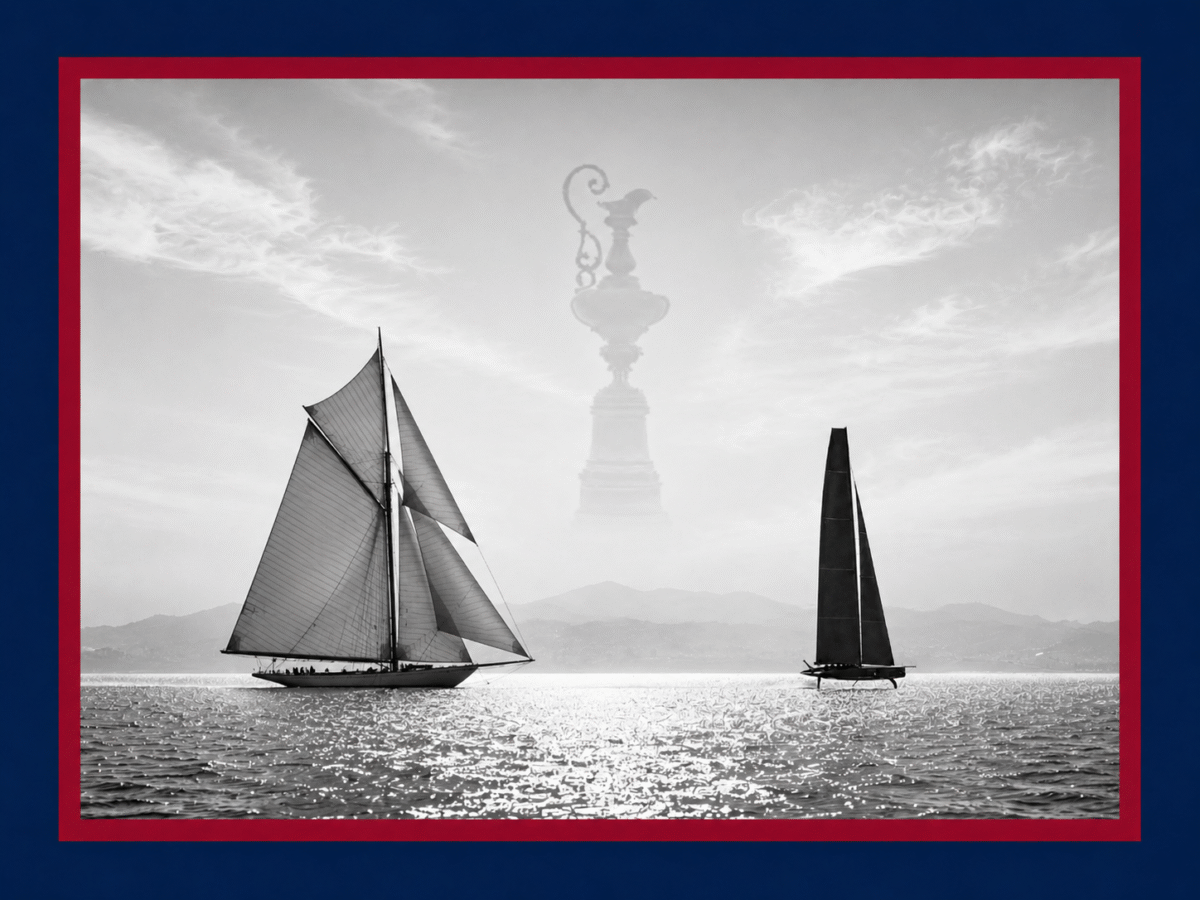
The America’s Cup is often described as the oldest international sporting competition still in existence. That definition is correct, but insufficient to capture its true complexity.
The distinctive nature of the America’s Cup does not lie solely in its history, in the speed of the AC75s, or in the technological sophistication achieved by contemporary sailing. It lies, above all, in its legal and regulatory architecture: a competition founded upon a nineteenth-century instrument, governed by mechanisms of a private-law nature, and gradually evolved into a system in which law, innovation, design and competitive advantage mutually influence one another.
The America’s Cup is, arguably, the only major international sporting event in which the principal contenders may contribute to redefining the rules of the future competition.
1. The Legal origins of the Cup
The fascination of the America’s Cup also lies in its historical and legal foundations, which display features that are, in many respects, unique within the landscape of international sport.
The competition originated in 1851, the year of the Great Exhibition in London, when the Royal Yacht Squadron, the most prestigious British yacht club, organised its traditional race around the Isle of Wight, offering as a prize a silver cup worth 100 guineas to the winner of the competition.
Fourteen British yachts took part in the race, joined by America, a 101-foot schooner representing the New York Yacht Club. The American vessel completed the race with a significant lead over the English challengers, winning the trophy which, from the name of the victorious yacht, would later become known as the America’s Cup.
A few years later, George L. Schuyler, the last surviving member of the group of owners who had co-financed the construction of the yacht America, arranged for the trophy to be donated to the New York Yacht Club by means of the document known as the Deed of Gift.
That instrument — in its version dated 24 October 1887, subsequently amended by orders of the Supreme Court of the State of New York in 1956 and 1985 — still constitutes the primary legal source of the America’s Cup and continues to define its fundamental principles, its structural framework, and its nature as an international competition between yacht clubs belonging to different countries.
2. The Deed ef Gift: The Fiduciary Architecture of the Cup
Unlike many modern sporting competitions, which are structured around federations, circuits or permanent organising bodies, the America’s Cup retains a distinctive matrix: a private challenge between yacht clubs, governed through a structure of a substantially fiduciary nature, whose interpretation and application fall within the jurisdiction of the Supreme Court of the State of New York.
The Deed of Gift establishes the essential architecture of the competition: a perpetual challenge between foreign yacht clubs, conceived “as a perpetual Challenge Cup for friendly competition between foreign countries”.
This is a legal structure that is unique within the landscape of international sport and which, even today, continues to shape the very nature of the Cup.
The 1887 Deed of Gift is not merely a historical “rulebook” of the competition.
In several respects, it presents features comparable to those of a true trust instrument, traditionally characterised by New York case law as a charitable trust, through which the trophy is formally transferred and held for specific purposes.
The yacht club holding the Cup — the Defender — therefore assumes a function substantially comparable to that of a trustee or temporary custodian, entrusted with preserving the trophy and making it available for future international challenges in accordance with the principles laid down in the Deed of Gift itself.
In most international sporting events, governance is vested in a federation or central organising body. In the case of the America’s Cup, by contrast, the system continues to be founded upon a nineteenth-century private-law instrument that defines the core principles of the competition, including:
•who may challenge the Defender: the challenge must come from an organised yacht club belonging to a country different from that of the Defender, and such yacht club must hold an annual regatta on the sea, on an arm of the sea, or on a course combining both;
• the terms of the challenge: the first challenging yacht club, the Challenger of Record, must give ten months’ written notice, stating the proposed dates for the races and indicating the name of the owner, together with a certificate containing the name, rig and dimensions of the challenging vessel;
• the Defender’s advantage: the challenged yacht club is not required to identify its representative vessel until the time agreed for the start;
• title to the Cup: the Cup does not belong to the owner of the winning yacht, but is held by the winning yacht club until the next award;
• the mutual right of the Defender and Challenger to determine the terms of the challenge: the parties may, by mutual consent, make any arrangement satisfactory to both as to dates, courses, number of races, rules and sailing regulations, as well as all other conditions of the challenge;
• the prevalence of the Deed of Gift in the absence of agreement: failing agreement between the Defender and the Challenger, the Deed operates as a default regime, setting out the essential parameters of the challenge;
It is therefore clear that, under the original system established by the Deed of Gift, the Defender enjoyed a structurally privileged position. The Challenger was required to disclose, well in advance, the essential elements of its yacht and of the challenge, whereas the Defender could delay the identification of its representative vessel until the time agreed for the start.
This asymmetry is one of the historical features of the America’s Cup and helps explain many of the tensions, negotiations and disputes that have accompanied the evolution of the competition over time.
A further distinctive element of the Cup’s legal architecture is the jurisdiction of the Supreme Court of the State of New York over disputes concerning the interpretation and application of the Deed of Gift. As the instrument establishing the fiduciary relationship governing the holding and custody of the trophy, the Deed continues to fall within the jurisdiction of the courts of the State of New York.
It follows that questions relating to the validity of a challenge, the proper application of the provisions of the Deed, or the exercise of the powers conferred upon the Defender may be brought before the Supreme Court, which is called upon to interpret and apply the text of the original fiduciary instrument.
The case law developed over the years has made a significant contribution to defining the legal boundaries of the competition and has had a direct impact on its evolution, giving rise to some of the most important disputes in the history of the Cup, which will be addressed in a subsequent analysis.
As the sporting, technological, economic and commercial complexity of modern campaigns has progressively increased, a second regulatory layer has gradually been added to the original system outlined by the Deed.
Contemporary editions of the America’s Cup therefore operate on two distinct but complementary levels: the Deed of Gift, as the permanent legal source of the competition, and the Protocol, as the negotiated set of rules governing each individual edition.
3. The Protocol and the private governance of the competition
If the Deed of Gift constitutes the permanent legal architecture of the competition, the Protocol represents the governance instrument for each individual edition, regulating its organisation, governance and principal operational rules.
Modern editions are governed by a detailed Protocol negotiated between the Defender and the Challenger of Record, namely the first yacht club whose challenge is formally accepted by the Defender. The latter thereby assumes a privileged institutional position in defining the regulatory framework of the subsequent edition of the competition.
Today, the Protocol regulates the essential aspects of each edition: sporting format, governance, technical rules, media and commercial rights, arbitration panel, nationality requirements, conditions of entry, the structure of the Event Authority, and operational matters.
The result is a highly autonomous model of private sporting governance, founded upon a balance between contractual autonomy, technical regulation and competitive organisation, which profoundly distinguishes the America’s Cup from almost all other international sporting competitions.
Modern America’s Cup teams operate as multidisciplinary organisations made up of sailors, engineers, aerodynamic specialists, legal advisers, data analysts, designers, media teams, and commercial and operational structures subject to constant competitive pressure. Within this environment, design confidentiality continues to represent an essential competitive factor, even within a technical platform that is progressively more stable than in many past editions.
In America’s Cup campaigns, performance arises from the interaction between sailing skills, design, control systems, data management, interpretation of the Class Rules, and the ability to operate within extremely sophisticated technical and procedural constraints.
From this perspective, the rules do not merely regulate the competition: they directly influence its technical, organisational and competitive evolution, becoming themselves an integral part of the challenge.
4. From the centrality of the Defender towards more shared models of governance
For much of its history, the America’s Cup remained an elite, cyclical competition, strongly dependent upon the balance of power between the Defender and the Challenger of Record.
Historically, the Defender has maintained a structurally privileged position in defining the format and rules of the subsequent edition, participating — together with the Challenger of Record — in the construction of the new Protocol, the class, and the competitive framework of the future Cup.
Long intervals between editions, disputes among challengers, continuous changes in format, and the absence of genuine structural continuity have often generated uncertainty for teams, sponsors and host cities.
In recent years, however, the America’s Cup appears to have embarked upon a gradual process of transformation aimed at making the competition more stable, continuous and sustainable from an organisational, economic and sporting perspective.
The evolution towards more structured partnership models, the search for more shared governance, the introduction of cost-containment measures, the new nationality rules, and the debate concerning a possible reduction in the interval between editions clearly reflect this transformation.
Particularly significant is the debate surrounding the possibility of making the competition more continuous and structured, thereby encouraging the creation of a more stable international ecosystem from sporting, industrial and commercial perspectives.
The tension between heritage and modernisation now appears to be one of the central themes of the contemporary Cup.
INDUSTRY INSIGHT
On board Perspective | Contribution by Pierluigi de Felice | Professional sailor | Former Mascalzone Latino and Luna Rossa team member.
I experienced the America’s Cup for almost fifteen years, from the 31st to the 36th edition, witnessing profoundly different phases of its evolution. And if I had to identify what has historically made this competition unique compared with any other international regatta, I would start precisely from its system.
One of the peculiarities I always perceived while experiencing the Cup from the inside was the ability of each edition to present itself as different from the previous one from a technical, organisational and regulatory perspective.
The original structure of the Cup has historically assigned the Defender a central role in shaping the following edition. Through its interaction with the Challenger of Record, this position contributed to defining fundamental elements of the future competition: format, class and technical framework.
This produced a very concrete consequence. The Challenger of Record acquired a position of advantage over the other challengers, not only at an institutional level, but also from an operational, design and timing perspective.
Preparing an America’s Cup campaign has always meant working over a time horizon of several years, and having additional months available could have a significant impact on the real competitiveness of the campaign.
For these reasons, the representative of the future Challenger of Record could already be present at the final event of the Cup, ready to formalise the new challenge immediately after the trophy had been awarded.
This is what happened at the final race of the 35th America’s Cup in 2017, when the President of Circolo della Vela Sicilia, who was present on board, handed the challenge letter to Steve Mair of the Royal New Zealand Yacht Squadron. The challenge was presented by Luna Rossa, which thereby became the Challenger of Record for the 36th America’s Cup.
The modern America’s Cup, however, has undergone a profound transformation. The introduction of foils in the most recent campaigns accelerated a process that was already underway: a progressive reduction in crew numbers, increasing automation, mechatronics, and the integration of sailing, technology and engineering.
Where once many adjustments were entrusted primarily to the sensitivity of the crew and to the human element, today competitiveness requires increasingly sophisticated systems.
The evolution of the most recent platforms and the current structure of the ACP format, envisaged for the 38th edition, have also progressively encouraged greater standardisation of certain elements of the competition.
This is a change which, on the one hand, tends to enhance execution quality, organisation and the overall performance of the teams, but which, on the other hand, is moving the Cup towards a competitive model that increasingly resembles other international sailing events based on one-design platforms.
A question therefore remains open, and will inevitably accompany the next editions: to what extent will this evolution be able to preserve those features which, for more than a century and a half, have made the America’s Cup a unique competition within the international sporting landscape?
5. Final considerations
If the most recent editions of the Cup appear to have favoured increasing technical continuity and a progressive stabilisation of the platforms and competitive format, one central element of the original architecture of the America’s Cup nevertheless remains.
The system built around the Deed of Gift continues, in fact, to allow the future Defender to exert a significant influence on the structure of the subsequent edition of the competition and to redefine part of the rules of the challenge itself.
It is probably precisely this distinctive ability to evolve from within — allowing the protagonists to influence even the rules of the future competition — that has enabled the America’s Cup to span more than one hundred and seventy years of history, while still preserving a fascination and uniqueness without equal in the landscape of international sport.
This contribution inaugurates the Waves & Law™ America’s Cup Series, dedicated to the analysis of the legal, regulatory and evolutionary aspects of the oldest international sporting competition still in existence.
Waves & Law™ is an editorial project curated by Avv. Gianmarco Capece Minutolo. © All rights reserved.
Studio Legale Capece Minutolo